
In the world of modern business analysis, the barrier to entry for creating professional diagrams has been significantly lowered by Artificial Intelligence. This tutorial explores the technical architecture behind AI-driven BPMN (Business Process Model and Notation) modeling, using a real-world “Employee Onboarding” scenario as our case study. We will deconstruct the visual elements shown in the diagram, analyze the underlying logic, and understand how “Conversational Ideation” transforms text into complex process models.
1. The Concept of AI-Driven Conversational Modeling
Traditional diagramming requires a user to manually select shapes, draw connectors, and define logic. AI-driven modeling, such as the system presented here, flips this workflow. It utilizes Natural Language Processing (NLP) to interpret a business problem—such as “I need to onboard a new employee”—and automatically constructs a coherent process model.
This approach shifts the user’s role from a “draftsman” to a “process architect.” You define the intent, and the AI engine handles the syntax and structural logic of the BPMN standard.
2. Decomposing the Visual Architecture
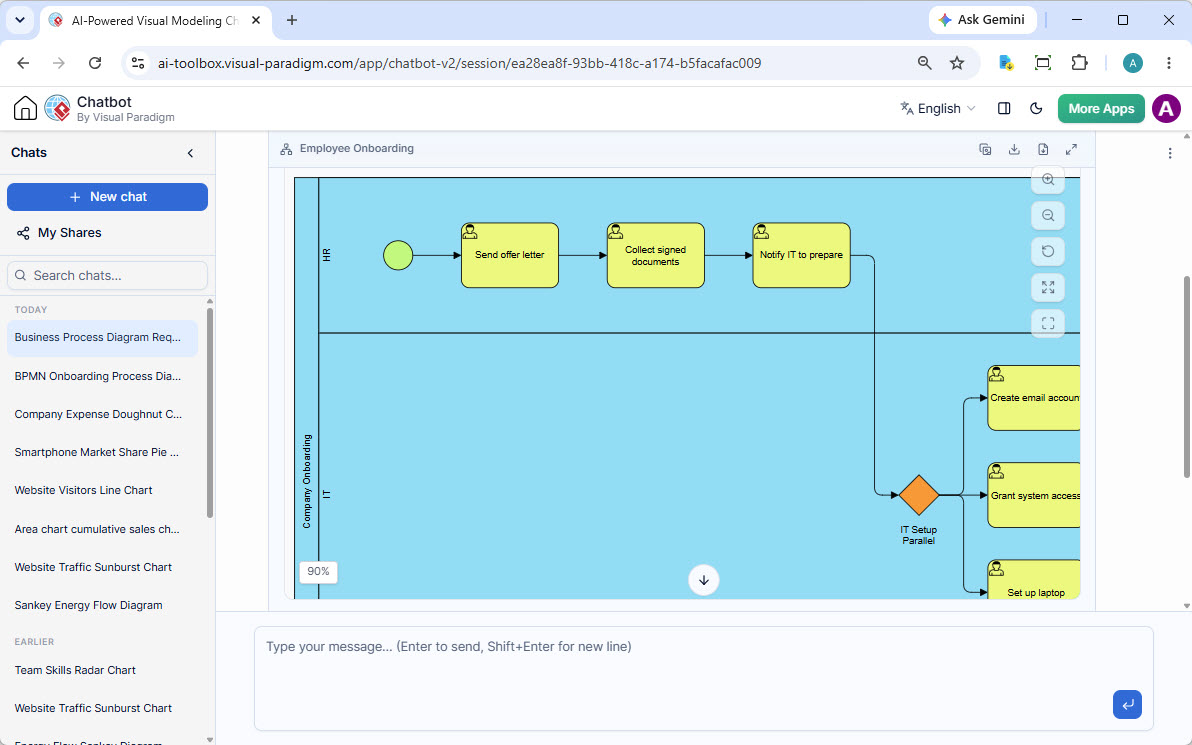
The screenshot displays a sophisticated modeling interface. To understand the system, we must break down the diagram into its constituent BPMN elements. This specific diagram illustrates a “Swimlane” architecture, which is crucial for defining organizational roles and responsibilities.
2.1 The Swimlane Structure
The diagram is divided into two distinct horizontal sections, known as swimlanes. This visual separation is essential for process clarity:
- HR Lane: Represents the Human Resources department, typically responsible for the initial administrative and legal aspects of hiring.
- IT Setup Lane: Represents the Information Technology department, responsible for the technical provisioning required for the employee to start work.
2.2 The Process Flow: Step-by-Step
The diagram follows a logical sequence of events. Let’s walk through the technical symbols:
- Start Event (Green Circle): The process initiates at the green circle. In BPMN terms, this is the trigger point where the “Onboarding” lifecycle begins.
- Sequence Flow (Arrows): The black arrows indicate the order of execution. The flow moves from left to right, representing the passage of time and the progression of tasks.
- User Tasks (Yellow Rounded Rectangles): These boxes represent activities performed by a human actor.
- Send offer letter: The first step in the HR lane.
- Collect signed documents: A dependency step following the offer.
- Notify IT to prepare: This is a critical hand-off point between departments.
3. Advanced Logic: Parallel Gateways
The most technically interesting part of this diagram is the transition from the HR lane to the IT lane. Notice the orange diamond shape labeled “IT Setup Parallel”. In BPMN, this is a Parallel Gateway.
What is the logic behind this?
Once the HR representative completes the “Notify IT to prepare” task, the process splits into multiple concurrent paths. The AI has identified that the following tasks do not need to happen sequentially; they can happen simultaneously:
- Create email account
- Grant system access
- Set up laptop
By using a Parallel Gateway, the system optimizes the onboarding time. If these tasks were sequential, the IT setup would take three times as long. The AI logic recognizes that these are independent resource allocations.
4. The “Ecosystem” Advantage
The context provided in the source material emphasizes that this tool is an “ecosystem,” not just a generator. This is technically significant for two reasons:
4.1 Context Retention
The AI maintains the context of the “Employee Onboarding” project. This allows for Iterative Refinement. If a user asks, “What if we need to train them before they get a laptop?”, the AI can modify the existing diagram structure rather than starting from scratch. It understands the relationship between the tasks.
4.2 Integration with Manual Editing
The interface shows a full-featured editor. The AI generates the “skeleton” of the process, but the human retains control. If the AI misses a specific compliance check, the user can manually add a task using the drag-and-drop editor. This hybrid approach—AI for speed, Human for precision—is the industry standard for modern business analysis.
Conclusion
By converting a simple text prompt into a structured BPMN diagram with swimlanes and parallel gateways, tools like Visual Paradigm’s AI Chatbot democratize the process modeling process. They allow business analysts to focus on the what and why of the business process, while the software handles the how of the diagrammatic syntax.