
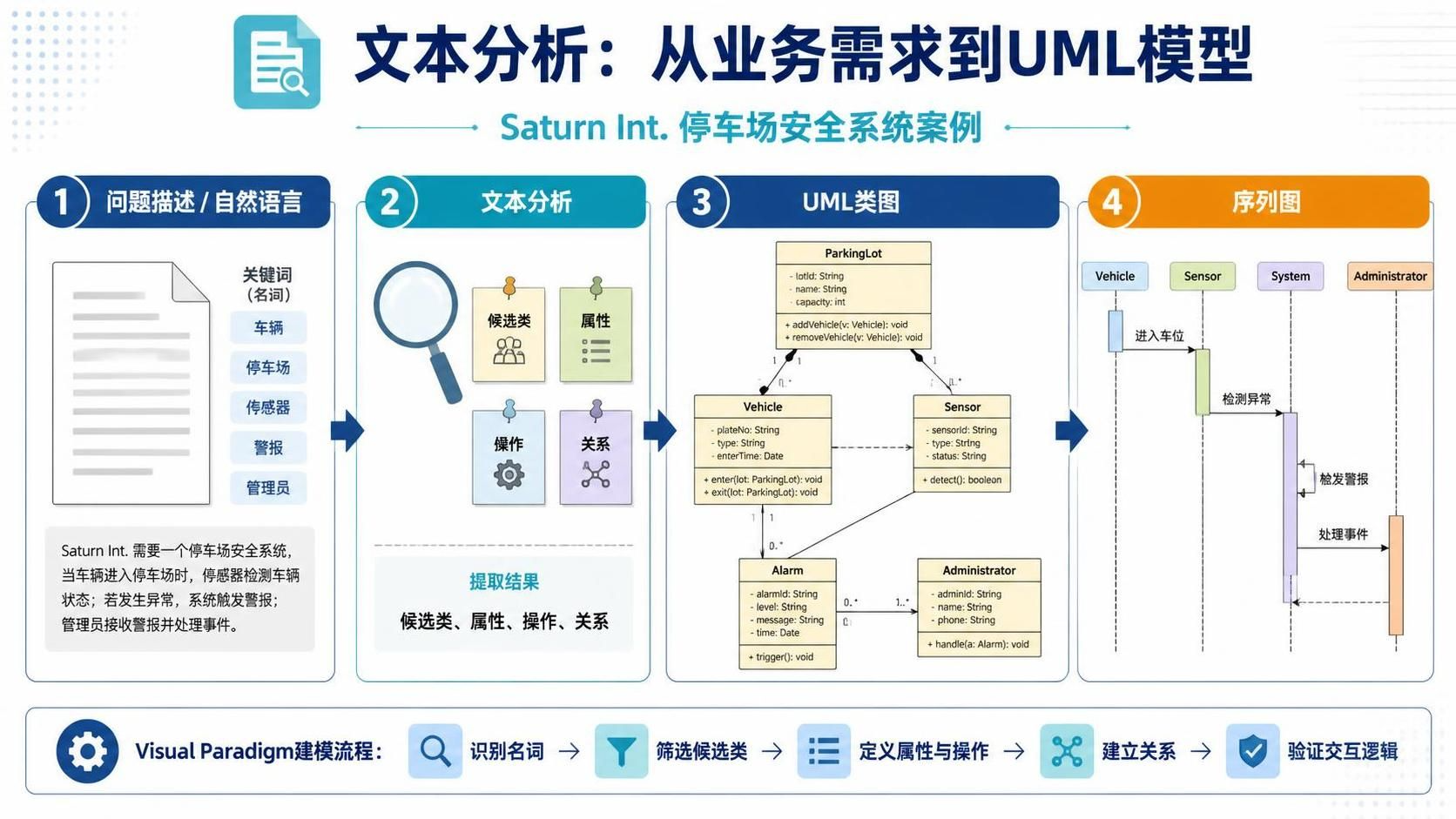
在软件工程的生命周期中,需求分析往往是最容易出错的环节。面对冗长的业务描述文档,开发团队常常难以快速捕捉核心逻辑。如何从“自然语言”的混沌中提炼出“结构化”的系统模型?答案是文本分析(Textual Analysis)。
本教程将基于经典的 Saturn Int. 停车场安全系统 案例,结合 Visual Paradigm 工具的最佳实践,为您演示如何像解剖学家一样,从一段业务描述中剥离出类、属性、操作及关系,最终构建出标准的 UML 类图 和 序列图。
一、核心方法论:从文本到模型的映射
文本分析的核心在于语法和语义的映射。我们需要将自然语言中的词汇映射为 UML 模型中的特定元素:
- 名词 (Nouns):通常映射为 类 (Classes) 或 接口 (Interfaces)。
- 动词 (Verbs):通常映射为 操作/方法 (Operations/Methods) 或 关系 (Relationships)。
- 形容词/描述性短语:通常映射为 属性 (Attributes)。
在 Visual Paradigm 中,这一过程可以通过 “Text to Model” 功能自动化完成,但理解背后的逻辑对于修正模型至关重要。
🚀 专家提示:如何避免“垃圾进,垃圾出”?
并非所有名词都是类。在识别候选类时,必须剔除角色名词(如“管理员”、“司机”)、数据类(如“数字”、“日期”)以及属性名词(如“卡号”)。记住:类应该是具有行为和状态的实体,而不仅仅是数据的容器。
二、实战案例:Saturn Int. 停车场系统
让我们开始实战。首先,我们需要明确系统的业务需求。以下是 Saturn Int. 提出的原始问题描述:
Saturn Int. management wants to improve their security measures, both for their building and on site. They would like to prevent people who are not part of the company to use their car park.

Saturn Int. has decided to issue identity cards to all employees. Each card records the name, department and number of a company staff, and give them access to the company car park. Employees are asked to wear the cards while on the site. There is a barrier and a card reader placed at the entrance to the car park. When a driver drives his car into the car park, he/she inserts his or her identity card into the card reader. The card reader then verify the card number to see if it is known to the system. If the number is recognized, the reader sends a signal to trigger the barrier to rise. The driver can then drive his/her car into the car park. There is another barrier at the exit of the car park, which is automatically raised when a car wishes to leave the car park. A sign at the entrance display "Full" when there are no spaces in the car park. It is only switched off when a car leaves. There is another type of card for guests, which also permits access to the car park. The card records a number and the current date. Such cards may be sent out in advance, or collected from reception. All guest cards must be returned to reception when the visitor leaves Saturn Int.
三、建模步骤详解
步骤 1:文本分析与识别
首先,我们通读上述文本,识别潜在的候选类。我们将名词提取出来:
- 实体候选:Saturn Int. (公司), Management (管理层), Car Park (停车场), Identity Card (员工卡), Car (车辆), Barrier (道闸), Card Reader (读卡器), Sign (显示屏), Guest Card (访客卡), Reception (接待处).
- 属性候选:Name (姓名), Department (部门), Number (编号), Date (日期), Status (状态).
- 操作候选:Issue (发放), Insert (插入), Verify (验证), Trigger (触发), Display (显示), Return (归还).
步骤 2:筛选与建模 (Visual Paradigm 视角)
使用 Visual Paradigm 的文本分析功能,系统会自动提取上述词汇。作为架构师,我们需要进行以下清洗工作:
- 排除非业务实体:”Saturn Int.” 是系统边界外的组织,”Management” 是抽象概念,通常不作为系统内的类,除非系统需要管理员工部门信息。在此我们将其作为系统的上下文,不建模为内部类。
- 合并属性:将 “Identity Card” 的属性(Name, Department, Number)直接归纳到类中,而不是创建独立的 “Name” 类。
- 确定主类:
- ParkingLot (停车场系统)
- Vehicle (车辆)
- CardReader (读卡器)
- Barrier (道闸)
- EmployeeCard (员工卡) / GuestCard (访客卡) —— 这里可以使用泛化关系,父类为 AccessCard。
- Sign (显示屏)
四、构建 UML 类图
基于分析结果,我们可以构建系统的静态结构。以下是构建 UML 类图 的推荐结构:
class ParkingLot {
    - location: String
    - capacity: int
    - currentOccupancy: int
    + addVehicle(v: Vehicle): void
    + removeVehicle(v: Vehicle): void
    + isFull(): boolean
    + displayStatus(): void
}

class Vehicle {
    - plateNo: String
    - type: String
    + enterLot(lot: ParkingLot): void
    + exitLot(lot: ParkingLot): void
}

class Barrier {
    - status: boolean
    + open(): void
    + close(): void
}

class CardReader {
    - readerId: String
    + readCard(card: AccessCard): boolean
    + sendSignal(action: String): void
}

class AccessCard {
    - cardNumber: String
    - expirationDate: Date
    + isValid(): boolean
}

class EmployeeCard {
    - department: String
    - employeeId: String
}

class GuestCard {
    - issuedBy: String
    - dateIssued: Date
}在此模型中,ParkingLot 作为核心控制类,管理 Vehicle 和 Barrier 的状态。同时,它依赖于 CardReader 进行身份验证。
🚀 专家提示:关系的选择
在 UML 建模中,区分关联 (Association) 和依赖 (Dependency) 是关键。例如,ParkingLot 和 Barrier 是强关联(道闸是停车场的物理组成部分),应该使用实线关联。而 ParkingLot 调用 CardReader 的方法,如果 CardReader 是外部设备,可以使用依赖关系(虚线箭头)。
五、动态建模:序列图 (Sequence Diagram)
类图展示了“有什么”,而 序列图 展示了“发生了什么”。针对“车辆入场”这一核心流程,我们绘制 序列图 如下:
title 车辆入场流程 (Sequence Diagram)

participant Vehicle
participant CardReader
participant ParkingLot
participant Barrier

Vehicle -> CardReader: 插入员工卡 (Insert Card)
activate CardReader
CardReader -> ParkingLot: 验证卡片信息 (Verify Card)
activate ParkingLot
ParkingLot --> CardReader: 验证通过 (Verified)
deactivate ParkingLot
CardReader -> Barrier: 触发上升信号 (Trigger Open)
deactivate CardReader
activate Barrier
Barrier --> Vehicle: 道闸升起 (Barrier Up)
deactivate Barrier
Vehicle -> Vehicle: 驶入停车场 (Drive In)
通过这个序列图,我们可以反向检查类图:
- Vehicle 类是否包含了触发进入的逻辑?
- CardReader 类是否具备验证接口?
- ParkingLot 类是否处理了验证后的状态变更?
六、总结与进阶
通过 文本分析,我们将一段复杂的自然语言描述转化为了结构清晰的 UML 模型。这不仅是画图的过程,更是梳理业务逻辑、发现潜在设计缺陷的过程。
在 Visual Paradigm 中,您可以利用 VPasCode 或文本分析插件,直接将上述描述的文本粘贴到工具中,自动生成类图草案,然后进行人工修正。这种“人机协作”的模式,将极大地提升系统架构设计的效率与准确性。
掌握从文本到模型的技术,是每一位现代系统架构师的必备技能。